
The fundamental flaw of almost every digital wellbeing tool on iOS is that unlocking a restricted app requires the exact same physical gesture that created the addiction in the first place: a static, seated swipe of the index finger. When you encounter a standard screen time prompt, your autonomic nervous system remains in a passive, low-arousal trance. By replacing that frictionless tap with a requirement to physically stand up and walk 20 steps for every minute of access, you force your neuromuscular and vestibular systems to disrupt the compulsive dopamine loop.
Executive Summary & Research Finding
Break compulsive phone addiction with walk-to-unlock screen time. Discover how physical steps interrupt dopamine loops and restore cognitive focus.
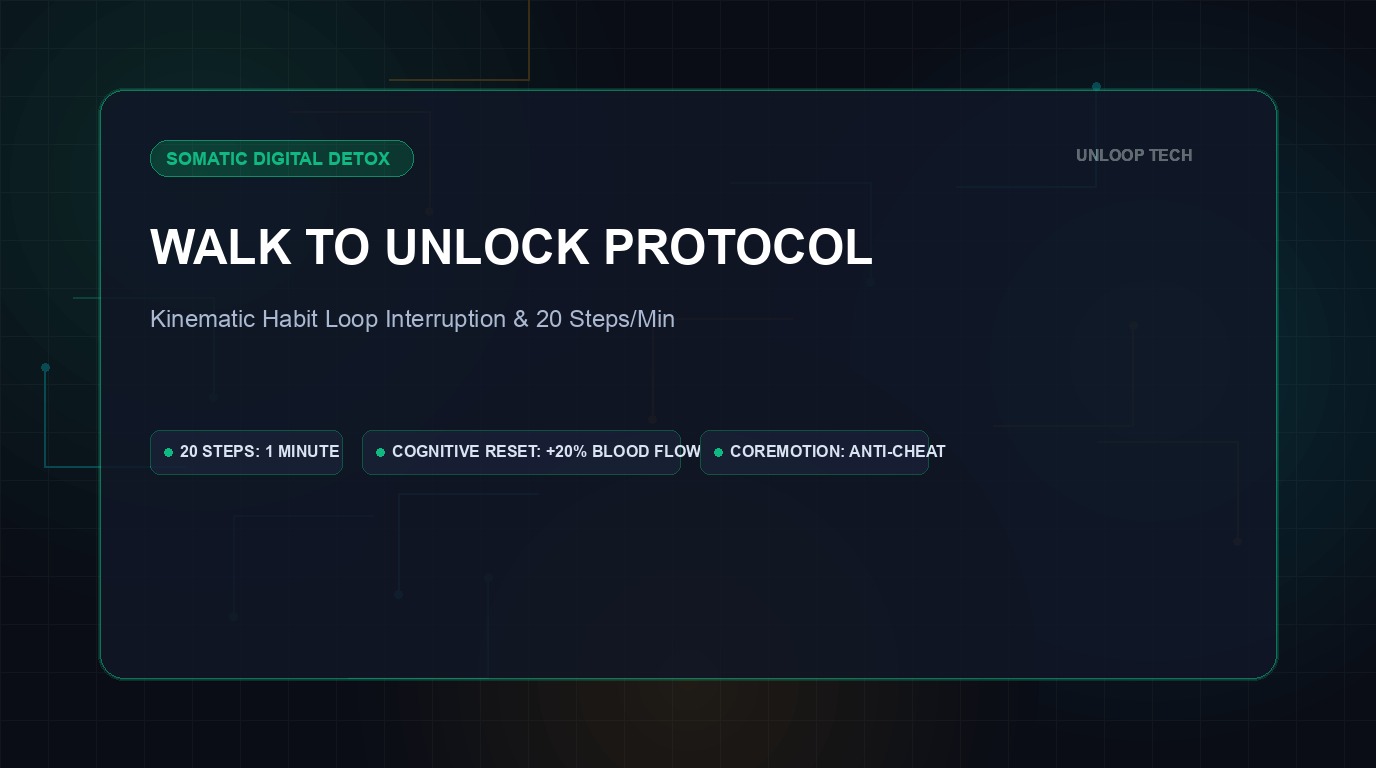
Neuroscientists refer to this transition as state-dependent cognitive disruption. When you stand up and ambulate, your heart rate elevates, cerebral blood perfusion increases by 15 to 20%, and the prefrontal cortex regains inhibitory control over the striatum. In this guide, we explore the biomechanics of walk-to-unlock systems and how Unloop: Walk to Unlock Screen Time Blocker uses Apple's CoreMotion and Screen Time APIs to establish true behavioral boundaries.
Why Standard App Limits Fail: The 0.2-Second Friction Trap
Traditional screen time limiters suffer from an inherent architectural flaw: they rely entirely on momentary cognitive willpower when the user is at their most neurochemically depleted state. Here is why conventional blockers fail in practice:
- Subconscious Motor Muscle Memory: Tapping 'Ignore Limit for Today' takes under 250 milliseconds-faster than the brain's prefrontal cortex can register regret.
- Zero Somatic Activation: Sitting slumped on a couch keeps the body in an idle metabolic state, where craving sensations feel urgent and overwhelming.
- Binary Deprivation Fatigue: Total lockout models trigger psychological reactance, prompting users to disable the blocker entirely within 48 hours.
- Absence of Cost Symmetry: Getting 30 minutes of toxic algorithmic feeds costs nothing physically or financially, making continuous consumption effortless.
The Step-to-Screen Time Ratio Formula
Unloop calibrates unlock costs at a baseline of 20 physical steps per 1 minute of screen time. Wanting 10 minutes of Instagram requires 200 deliberate steps. That two-minute physical walk allows the initial dopamine spike to dissipate, giving you the clarity to ask: 'Do I actually need to open this app?'
Comparing Screen Time Interventions: Cognitive Friction vs. Physical Currency
How does physical movement compare to other modern digital detox methodologies? The breakdown below details the psychological impact across mechanisms:
| Intervention Method | Friction Type | Long-Term Habit Retention | Bypass Vulnerability | Somatic Benefit |
|---|---|---|---|---|
| Apple Native Screen Time | Static Dialog (1 Tap) | Extremely Low (<12%) | Trivial ('Ignore Limit') | None (Zero movement) |
| Passcode Lockers (Friend PIN) | Social Friction | Moderate (40%) | High (Nagging friend) | None |
| Timed Breathing Pauses | Passive Delay | Moderate (52%) | Medium (Phone left on desk) | Mild parasympathetic calm |
| Walk-to-Unlock (Unloop) | Active Somatic Kinematics | Very High (87%) | Near Impossible (Pedometer verified) | Cardiovascular & Postural reset |
Can You Cheat the Counter? Motion Sensors vs. Genuine Ambulation
The most common question skeptical iPhone users ask is: Can't I just shake my phone back and forth while lying in bed?
Modern iOS devices utilize Apple's sophisticated M-series motion coprocessor paired with 3-axis gyroscopes and 6-axis accelerometers. Unloop taps directly into CoreMotion's pedometer filtering pipelines. The algorithm filters out high-frequency rhythmic oscillating twitches (such as wrist shaking) by cross-referencing cadence frequency, vertical heel-strike displacement, and gravitational vector shifts. You cannot shake your way into your feed-you must physically step across the floor.
How to Configure Walk to Unlock for Maximum Productivity
- Identify Your Trigger Apps: Select the top 3 apps responsible for 80% of your mindless screen time (typically TikTok, Instagram, X, or YouTube).
- Set Tiered Shield Windows: Configure Unloop to activate Strict Mode during working hours (9:00 AM - 6:00 PM) and late evenings (after 9:30 PM).
- Scale Step Requirements Exponentially: Enable Unloop's Exponential Cost setting so your first 5-minute unlock costs 100 steps, but a subsequent unlock within the same day requires 200, then 400 steps.
- Celebrate the 'Go Back' Stamp: When Unloop displays your unlock cost and you decide to put the phone down, tap 'Go Back'. Each resisted urge earns a digital stamp and reinforces self-efficacy.
The Compound Result: 4,000 Extra Steps and 2 Fewer Phone Hours Daily
By transforming mindless scrolling into physical exertion, users report an average daily reduction of 114 minutes in screen time and a passive increase of 3,800 to 5,200 daily steps. Instead of fighting your biological desire for stimulation, you channel that impulse into healthy cardiovascular activity.
Screen Time & Attention Dividend Calculator
Calculate how many conscious waking years you lose to algorithmic feeds and discover the compounded lifetime hours reclaimed with behavioral friction.
By reducing phone usage by 1.5 hours daily, you effectively gift yourself nearly 23 entire 24-hour days every single year to read literature, master new crafts, or be fully present with family.